Research
My work sits at the intersection of embodied intelligence and multimodal learning: teaching robots to act in unstructured environments, and giving them senses beyond vision to do it with.
Two threads run through it. The first is simulation and synthetic data: building environments and generative pipelines that produce supervision at a scale real-world collection cannot reach, then closing the gap back to reality. The second is evaluation, benchmarks that measure what models can actually do, rather than what they appear to do.
Alongside this, I have worked on theoretical machine learning: critical batch size and scaling laws, statistical inference, and spectral methods for high-dimensional learning.
Publications
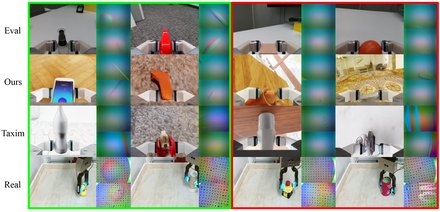
Learning Open-World Visual–Tactile Grasp Stability Prediction with Synthetic Data
Grasp stability from vision and touch, trained on FEM-simulated data that beats both real data and rigid-body simulation on unseen objects.
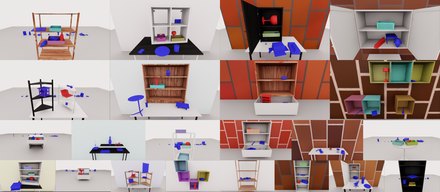
FetchBench: A Simulation Benchmark for Robot Fetching
A benchmark for robot fetching in procedural scenes where grasping and motion planning are both required. Baselines from sense-plan-act pipelines to end-to-end policies top out at 20 percent success.